Corporate and Governance
GRI 3-3
Governance, ethics and compliance
Swatch Group is committed to transparent and fair corporate governance. The Group’s actions are determined by ethical principles and the respectful use of resources. The Group observes a zero-tolerance policy both internally and with suppliers with regard to violations of human rights, e.g., child labor, forced labor, corruption and other criminal acts.
GRI 2–9, 2–12
Governance structure
Effective and transparent governance is central to the success of the company.
Swatch Group implements lean and efficient governance structures at all levels. While the Board of Directors is responsible for executive management, strategy and monitoring, the Executive Group Management Board is responsible for operational management tasks, in which it is supported by the Extended Executive Group Management Board. The Board of Directors is made up of seven members and has an Audit Committee and a Compensation Committee.
↗ For further information about the governance structure, please see the Corporate Governance Report in the Swatch Group Annual Report
GRI 2–9, 2–12, 2–13, 2–14 , 2–16
Sustainability governance
The Executive Group Management Board is responsible for ensuring compliance with the Group’s high standards in the area of sustainability. It embeds the approach to corporate responsibility in the corporate strategy and defines specific targets and measures. Implementation is coordinated and managed by the Sustainability Steering Committee, which includes representatives from the Board of Directors and the Executive Group Management Board. The Group’s approach to corporate responsibility is approved by the Board of Directors, which has the ultimate responsibility.
Corporate sustainability structure
Sustainability Steering Committee
The Sustainability Steering Committee is responsible for Swatch Group’s strategy and performance in the area of sustainability. The members are in constant contact with the Sustainability Team and usually meet every three months.
The Sustainability Steering Committee reports directly to the Executive Group Management Board at the Board’s monthly meetings. The CEO raises the issues that are important for the Board of Directors with the committee members.
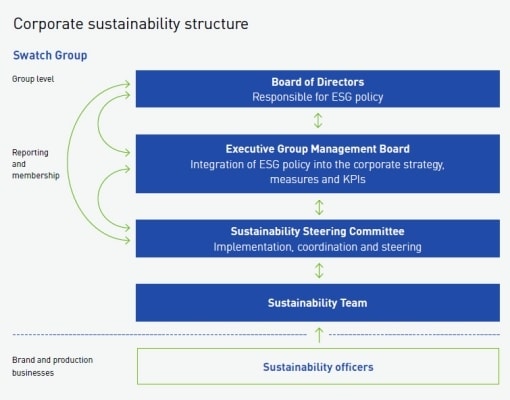
Sustainability Team
The Sustainability Team is responsible for the implementation of the company’s sustainability strategy and policy.
The team supports the brands, production sites, in-country organizations and central functions in their projects and initiatives and serves as a communication platform for the individual Group companies. The Sustainability Team consolidates the sustainability data of the operating entities and Group functions and prepares the Group’s sustainability report. It answers questions from internal and external stakeholders.
Sustainability officers at the subsidiaries
The sustainability officer ensures the advancement of the sustainability strategy for their brand, company or company entity, and defines and implements a specific roadmap.
The sustainability officer collects the data needed for the sustainability reports of the Group and its individual companies.
The larger company entities have had sustainability officers for a while. The corporate sustainability structure has grown further in recent years, and all companies now have their own sustainability officer.
Central functions - Energy Management
The main objective of the Energy Management team is to reduce the consumption of multifluid energy while ensuring productivity, eliminating avoided consumption, in order to achieve climate neutrality in Scope 1 by 2050 for all Swatch Group sites. This objective also includes reducing Scope 2 emissions as well as increasing plant lifespans to contribute to the control of Scope 3 emissions. To achieve this objective, emphasis has been placed on energy optimization and source substitution in heat production. The Energy Management team also supports companies in the development of energy concepts incorporating simultaneous heating and cooling requirements, as well as in the implementation of energy optimization measures.
Steps are also being taken to minimize emissions from the loss of refrigerants and to reduce emissions from processes.
Another objective is to achieve climate neutrality in Scope 2 by 2050 through renewable energy purchases, and to increase energy self-sufficiency by reducing dependence on external sources, through the integration and exploitation of innovative self-production and self-consumption technologies.
Challenges such as transition, energy security and quality, minimum energy consumption and new technologies are at the heart of the concerns of the Energy Management working group. At the same time, in cooperation with the EnAW (Energy Agency of the Swiss Private Sector) as an external partner, the legal bases, the development of the energy market and the achievement of the set targets are reviewed regularly in order to be able to react to changes as flexibly and quickly as possible. 2025 marks a milestone with the completion of new energy audits to comply with the requirements of the Swiss CO2 Act.
The long-standing agreement with the Swiss Federal Office for the Environment (FOEN) to reduce carbon emissions serves as an overarching guideline for the Energy Management team in achieving the set targets. Concrete carbon reduction targets were submitted to FOEN via the CORE platform, and the official validation of these was communicated to Swatch Group.
Statement on the Modern Slavery Act
Download the Swatch Group's statement on its efforts against slavery and human trafficking, made in compliance with section 54 of the UK Modern Slavery Act 2015.
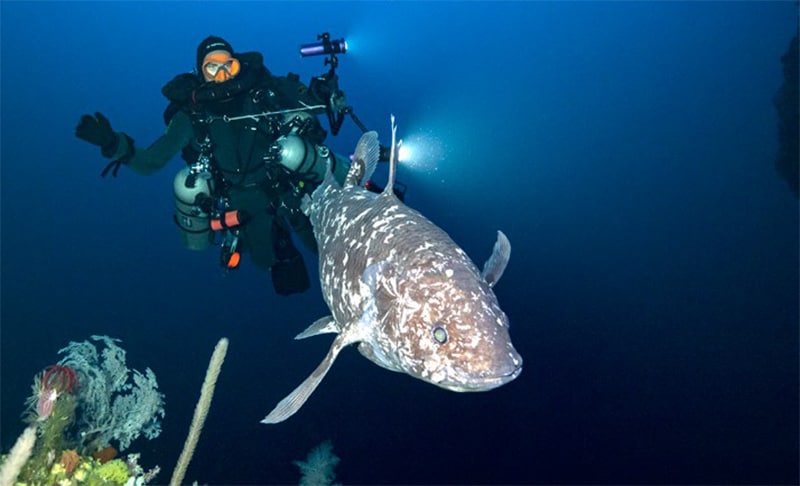
| Blancpain Ocean CommitmentMore than 20 years of action for the ocean Since the creation of the Fifty Fathoms – the first true diver’s watch – in 1953, Blancpain has been a pioneer in supporting the ocean community. Through its Ocean Commitment program, the Maison has backed more than 40 major scientific expeditions, helped protect 4.7 million km2 of ocean (almost twice the size of the Mediterranean Sea), and promoted awareness via powerful imagery and outreach. Blancpain’s continued dedication to ocean exploration led to a groundbreaking discovery announced in April 2025: the first observation of a living coelacanth in the Maluku archipelago, in Indonesia. Alexis Chappuis and UNSEEN Expeditions brought back the first images ever taken by divers of the Indonesian coelacanth (Latimeria menadoensis) in its natural habitat at a depth of 145 meters. Following Laurent Ballesta’s legendary encounter with the Indian Ocean species in South Africa in 2013, this new chapter – once again proudly supported by Blancpain – is a breathtaking reminder that the ocean remains largely unknown and that exploration is as relevant as ever. Coelacanths are flagship species that bring local and international attention to conservation efforts. Establishing Marine Protected Areas (MPAs) will safeguard coelacanth habitats and preserve the entire ecosystem, benefiting countless marine species. About the coelacanth
|