Environment
Environmental protection is firmly anchored in all Swatch Group divisions and companies, and represents a core priority that is respected, promoted and implemented daily by every employee in the company. The Group applies this conviction along the entire value chain, from product design and production processes to the recycling of its products. The Group’s brands develop new products using recycled or recyclable, organic and compostable materials wherever possible. In order to efficiently implement the Group’s strategy for sustainable product design, the company conducts Life Cycle Assessments (LCAs) to identify and minimize environmental impacts.
↗ Further information on LCAs can be found on p. 29 of the Sustainability Report.
In addition, measures to reduce energy and resource consumption are being implemented, whether through manufacturing facilities with smart energy control systems or through energy-efficient, heat-insulated and eco-friendly infrastructures and production sites. To optimize ecological and energy performance, ultra-modern technologies and building materials are used for new production buildings, other buildings and renovations; this practice also led to a further improvement in the year under review.
Data acquisition is being continuously improved in terms of both the quality of collection methods and new identifiers. However, it should be noted that due to their diversity, the business entities set their own targets and measures for many key figures, which are not presented in this report in a consolidated form.
↗ Further information on data collection can be found on p. 112 of the Sustainability Report.
GRI 3-3
Energy and emissions
Production, sourcing and sales: Energy is needed to operate buildings and facilities. In addition, there are indirect emissions (Scope 3) from sources such as suppliers, transport and raw materials.
Use of products: The use of Swatch Group products is associated with very low greenhouse gas emissions. Mechanical watches, for example, are powered by kinetic energy, while quartz watches are powered by solar cells or by batteries produced by the company’s own battery production facility, which runs on renewable electricity.
As early as 1990, Swatch Group campaigned for a reduction of GHG emissions and lower energy consumption through its sponsorship of the solar mobile The Spirit of Biel / Bienne. The solar mobile won the World Solar Challenge in Australia at the time. The first solar-powered Swatch (1995) stems from this period, and it has lost none of its appeal. As a result, the Group’s early commitment to protecting the climate remains an important value, and Swatch Group remains motivated to play its part in sustainable climate action in the long term.
 |
The Group aims to achieve the goal of climate neutrality for Scope 1 and Scope 2 by 2050. A strategy to reduce greenhouse gas emissions has been developed; the targets are reviewed regularly and, if possible, a faster reduction strategy is implemented.
In order to reduce Scope 1 emissions, targets for energy efficiency gains and GHG reductions have been set for all production units in Switzerland since 2013, and they apply generally to the entire Group on a consolidated basis. Production sites and distribution companies located outside Switzerland, in particular the many boutiques and service centers, are also working to improve their energy performance. Although the boutiques and service centers consume far less energy than the production plants in Switzerland, they are nevertheless included in the range of measures to reduce emissions and energy consumption.
Strategy for achieving climate goals
To achieve its reduction targets, Swatch Group has set a neutrality target for each of its sites and is focusing mainly on those that emit the most CO2. Six principles form the basis of its thinking (see box on the right).
Swatch Group is focusing on three main areas in its efforts to implement the energy transition in industry:
- Reviewing and optimizing existing energy concepts to reduce energy consumption and optimize the comfort and management of buildings. Replacing heating, ventilation and cooling systems in older buildings using state-of-the-art technology.
- Using clean energy from mainly renewable sources such as hydroelectric and photovoltaic, but also considering biogas and district heating from renewable sources in the region.
- Constantly monitoring technical innovations related to energy storage, green hydrogen production and sustainable biogenic fuels.
All of this helps to reduce the Group’s overall need for energy and gradually replace fossil fuels with renewable energy sources.
| 1. Avoid the use of resources that have no associated benefit. |
| 2. Reduce energy consumption to the necessary and technically feasible minimum. |
| 3. Efficient and effective operation of installations, as well as heat recovery. |
| 4. Alternative to fossil-fuel energy sources, such as regenerative or zero-carbon energy sources. |
| 5. Independent generation or conversion of energy at the sites themselves. |
| 6. Energy storage systems and carbon offsetting projects. |
Replacing these energies hinges mainly on the recovery of waste heat while factoring in the simultaneous need for heating and cooling. To cover the heat deficit not covered by this recovery process, efforts are underway to make a switch to electric production systems. This approach aims, on the one hand, to reduce the overall primary energy requirement linked to Scope 1 and, on the other hand, to increase energy self-sufficiency by exploiting available resources at each site, recycling waste heat and controlling Scope 2 electricity requirements.
Swatch Group is taking the following measures to reduce the impact of the progress of its decarbonization projects on Scope 2:
- Reducing the power consumption of machinery through technological and organizational optimization measures based on energy monitoring, such as the implementation of planned shutdowns at the end of production; developing energy concepts aimed at optimizing the heating and cooling requirements of production machinery, and adjusting power levels and temperatures in line with actual production needs and climatic conditions. These concepts also include the possibility of taking advantage of external conditions of using what’s known as “free energy,” such as free cooling, with maximum efficiency.
- Investing in photovoltaic systems on the roofs of buildings belonging to the Swatch Group.
- Electricity procurement from fossilfree energy sources.
Specific targets for reducing Scope 1 and Scope 2 GHG emissions have been set for each company.
The Group monitors progress twice a year. All companies benefit from technical guidance on the steps to be taken to optimize and replace existing systems, which presents various suggestions for reducing the carbon footprint and allows each entity to steer its decarbonization according to its past performance and the Group’s strategy.
Swiss production plant environmental program
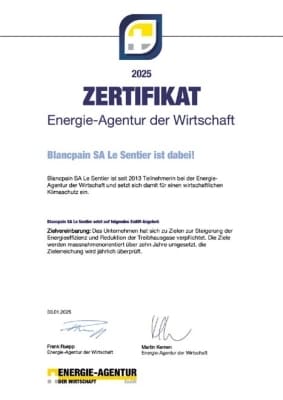
In 2013, with the support of the Energy Agency of the Swiss Private Sector (EnAW), Swatch Group signed a binding target agreement with the Swiss Federal Office for the Environment (FOEN) on stationary greenhouse gas emissions (Scope 1). All Swiss production units are bound by this agreement and contribute, through their measures, to achieving the Group’s energy targets. The first agreement covered the 2013–2021 period and was extended until 2024. New target agreements with the FOEN are currently being drawn up with the support of the EnAW. In 2025, Swatch Group extended its commitment to the Swiss Confederation in order to meet the requirements of the CO2 Act as part of this new agreement.
| Ruedin: Production site entirely free of fossil energyInnovative technology! In March 2024, Manufacture Ruedin launched a major energy retrofit project involving 7656 m2 of production buildings. This initiative is fully in line with Swatch Group objectives, which aim to significantly reduce the environmental impact of operations while optimizing the energy performance of infrastructure.
The renovation began with the improvement of the thermal envelope of the site, an essential step in reducing energy losses. It was complemented by the introduction of new heating, ventilation and cooling systems designed to ensure more efficient operation of industrial plants. Prior to this transition, fuel oil consumption generated on average 500 metric tons of CO2 a year, with energy expenditure of approximately 200 000 Swiss francs a year and a primary energy requirement of 1800 megawatt hours a year. This energy conversion hinged on a major innovation: a 360 m3 underground water reservoir used as a natural heat accumulator. This water turns into ice during the winter season, providing the capacity needed for cooling the production facilities and the primary energy input for the heat pumps. During the summer, the accumulated energy will be used to cool the machinery and production buildings. Three air source heat pumps complete and secure the system while exploiting a renewable resource: outdoor air. The site has been completely fossil-free since October 1, 2025, marking a milestone in the energy transition and climate commitment. Mobility As of April 2025, the company has completely replaced the diesel vehicles used for customer logistics and deliveries with a fleet of electric vehicles. This transition is part of the drive to reduce its carbon footprint and improve the environmental performance of operations. In addition, an electric vehicle was also purchased to meet the professional mobility needs of employees.
|